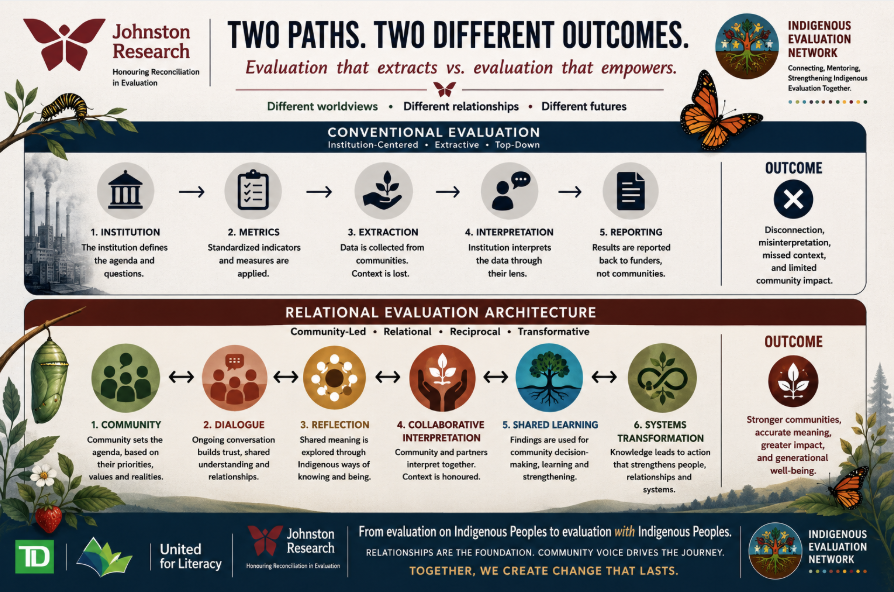
Through a partnership between Johnson Research and the Indigenous Evaluation Network, the following model emerged from the 2026 Indigenous Evaluation Summit findings and reporting. The articulation and development of this model were also informed and supported through Johnson Research’s Council on Knowledge, which oversees and accredits Johnson Research’s Indigenous Evaluation online learning modules and helps ensure the integrity, quality, and advancement of Indigenous evaluation education and relational learning practices.
Further, recent research conducted in partnership with Johnson Research, the Indigenous Evaluation Network, and United for Literacy, funded by TD Bank Canada, was also instrumental in developing this model. This collaborative work supported the advancement of relational Indigenous evaluation approaches grounded in community voice, accessibility, systems reflection, Indigenous knowledge systems, and community-informed pathways for evaluation and learning.
The Redefining Indigenous Evaluation Model was developed to help organizations, institutions, funders, and communities better understand the difference between evaluation systems that extract information from Indigenous Peoples and evaluation systems that empower Indigenous Peoples through relationship, reciprocity, and community-defined meaning.
Grounded in Indigenous ways of knowing and doing, the model reflects national conversations, community voices, systems mapping exercises, Indigenous evaluation gatherings, and collaborative dialogue emerging from the 2026 Indigenous Evaluation Summit. The model illustrates how evaluation can move beyond rigid institutional metrics and toward relational accountability, collaborative interpretation, shared learning, and systems transformation.
The model also reflects Johnston Research’s 25 years of business expertise and experience working alongside Indigenous communities, including understanding Indigenous worldviews, knowledge systems, community realities, and relational approaches to engagement. Rather than taking an extraction-based approach to evaluation, Johnston Research worked collaboratively with communities and the Council on Knowledge to help develop and support community-informed pathways for evaluation, systems reflection, Indigenous indicator development, and relational accountability grounded in community voice and lived experience.
The Redefining Indigenous Evaluation Model